The Dutch Golden Age · Artwork 009
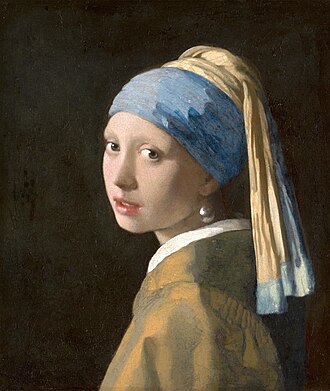
Girl with a Pearl Earring
Johannes Vermeer
A face turning through light
Not a named portrait but a tronie, this concentrated study of expression, costume, and light transforms an unknown model into an unforgettable encounter.
Historical Context
Painted in Delft around 1665, the work belongs to the Dutch tradition of the tronie: an imaginative character study rather than a commissioned likeness. The fanciful turban and dark setting remove the girl from ordinary time and place.
The Encounter
Her body turns away while her head returns toward us. Direct eye contact and parted lips make the instant feel spontaneous, yet the identity of the sitter and the meaning of her expression remain unresolved.
Color and Light
Costly natural ultramarine gives the blue turban exceptional depth. Yellow cloth, luminous flesh, a white collar, and a few wet highlights emerge from darkness through alternating opaque paint and thin glazes.
The Pearl
The earring is an optical performance made from only a few strokes. A bright highlight, a softer reflection from the white collar, and the surrounding darkness make the eye invent a sphere, even though no contour or hook is visible. Its exceptional size makes a real pearl unlikely; it may suggest polished metal, glass, or an imagined jewel.
Hidden Background
The ground now appears nearly black. Technical imaging found that Vermeer originally painted a translucent green curtain behind the figure; changes in pigments and glaze caused its folds to fade from view.
Look Closely
- Follow the highlights from eyes to lips to pearl.
- Compare the sharp collar with the softened cheek.
- Notice how the head and torso turn in opposite directions.
- Imagine the lost green curtain behind the silhouette.
Look Closely
Vermeer builds the encounter from a handful of precise optical events. Move from gaze to pearl, then notice what time has changed.
12345
- 1The gaze. Eye contact arrives at the instant the head turns, creating intimacy without explanation.
- 2The earring. No contour or hook is visible; highlights and surrounding darkness make the eye invent a sphere.
- 3The ultramarine turban. Costly lapis-lazuli blue gives the imaginative costume extraordinary depth.
- 4The parted lips. Soft edges and wet highlights make a silent image feel about to speak.
- 5The lost green curtain. Scientific imaging revealed folds in a background that now appears almost black.
Timeline
- 1632 Vermeer is born in Delft.
- 1653 He joins the Guild of Saint Luke.
- c. 1665 He paints Girl with a Pearl Earring.
- 1881 The neglected work is bought at auction for 2.30 guilders.
- 1902 It enters the Mauritshuis collection.
- 1994 / 2018 Major conservation and scientific research projects reveal how Vermeer built the image.