Artwork 013 - Post-Impressionism
Museum Catalogue Entry
Self-Portrait
Vincent van Gogh
A face built from moving color
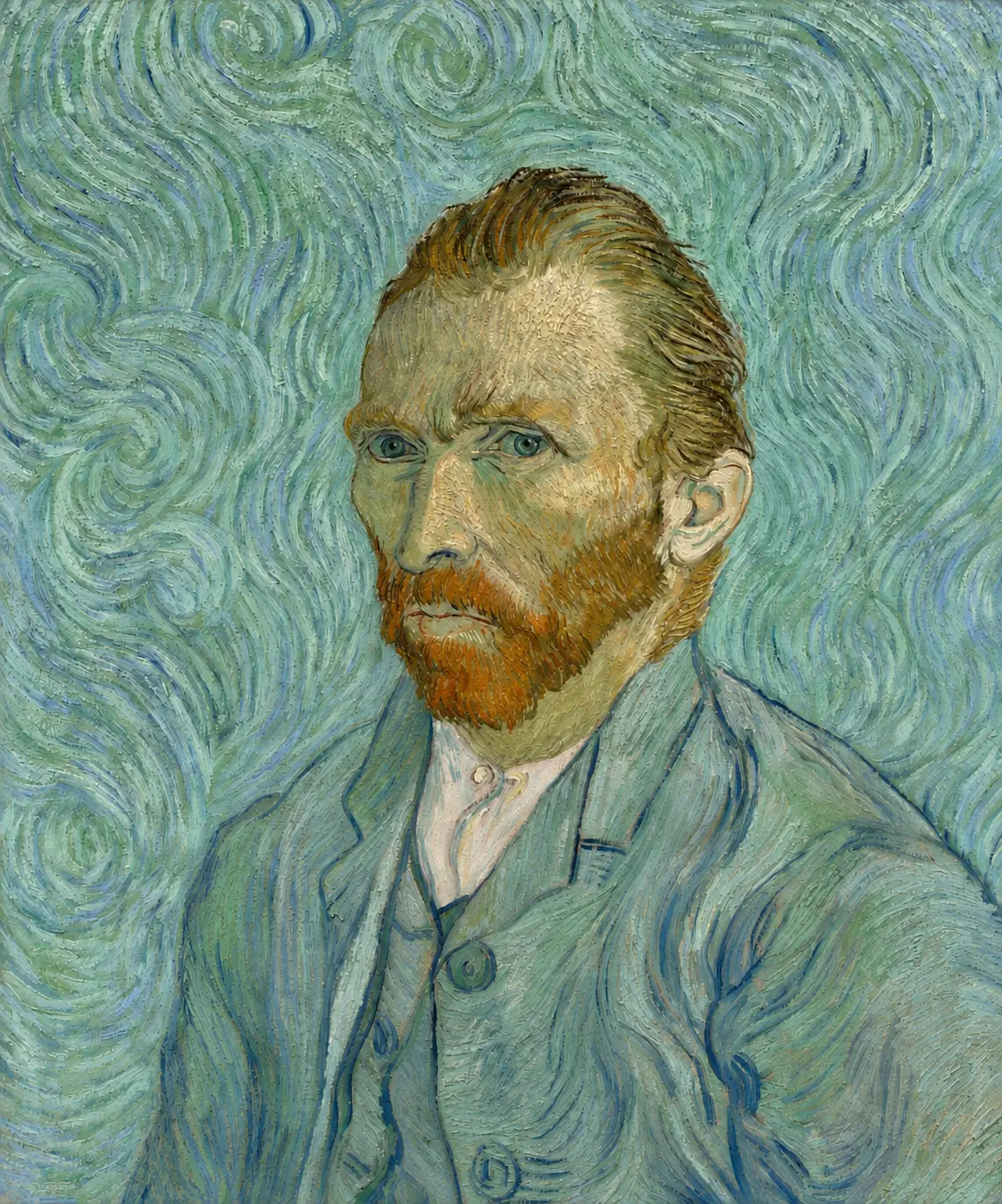
Van Gogh does more than record his appearance: every directional mark turns color, touch, and direct eye contact into a vivid account of artistic identity.
Historical Context
Van Gogh painted this self-portrait at Saint-Rémy in September 1889. Now held by the Musée d’Orsay, it belongs to the final phase of his self-portraiture and turns controlled posture, complementary colour, and rhythmic brushwork into an intense act of self-examination.
Artist Biography
Vincent van Gogh used self-portraiture as both necessity and experiment. Unable to hire models often, he studied his own face repeatedly, turning self-observation into one of the most intense visual diaries in modern art.
Color Palette
The portrait vibrates through complementary contrasts: red-orange hair and beard against blue-green surroundings, with yellow, rose, teal, and dark violet-brown marks woven into the surface.
Brushwork
Short, directional strokes construct the face, jacket, and background. The marks do not simply describe forms; they make the painting feel restless, alert, and psychologically charged.
Composition
The head turns in three-quarter view while the gaze meets the viewer directly. The dark jacket stabilizes the bottom of the image, while the active background presses forward around the figure.
Look Closely
- Trace how the brushstrokes change direction around the brow, cheek, and beard.
- Compare the red-orange beard with the blue-green background.
- Notice how the background feels active rather than empty.
A face used as an artistic laboratory
Van Gogh used self-portraiture throughout his career as a practical and psychological laboratory. The 1889 Musée d’Orsay portrait belongs to the culminating Saint-Rémy group: the formal jacket steadies the bust while pale turquoise and green strokes circulate around the head, setting the orange beard into chromatic vibration. Rather than simply recording likeness, the painting turns his own face into a study of identity, colour, and inner intensity.
Look Closely
Follow the direction of the marks before reading the face as a likeness. Van Gogh lets every stroke describe both form and emotional pressure.
12345
- 1The direct gaze. The eyes interrupt the swirling surface and hold the viewer in a tense encounter.
- 2Complementary color. Orange-red beard strokes vibrate against blue-green surroundings.
- 3An active background. Repeated marks turn empty space into a charged atmosphere.
- 4The dark jacket. Its weight anchors the lower image while preserving the directional rhythm.
- 5Strokes that follow form. Marks curve around brow, temple, and cheek instead of hiding the painter's hand.
Timeline
- 1853 Van Gogh is born in Zundert, Netherlands.
- 1886 He moves to Paris and studies modern color and brushwork.
- 1887 He paints numerous experimental self-portraits.
- 1888 He leaves Paris for Arles, where his color intensifies further.
- September 1889 He paints the Self-Portrait now held by the Musée d’Orsay.
Digital Interpretations
The People Behind the Painter
Jo van Gogh-Bonger: building Vincent's legacy
After Vincent died in 1890 and Theo in 1891, Jo inherited hundreds of paintings and drawings as well as the brothers' correspondence. She did not simply preserve them: she lent works to exhibitions, arranged selective sales, built relationships with critics and collectors, and kept a central group together.
Her 1905 exhibition at Amsterdam's Stedelijk Museum presented 472 works. In 1914 she published Vincent's letters to Theo in three volumes, allowing readers to encounter his artistic ideas in his own words. This sustained work was decisive in the growth of Van Gogh's international reputation.
Scan Jo's photograph. The AR layer places her available 3D model above the image, plays a short musical introduction, then continues with the English narration.