Artwork 015 - Post-Impressionism
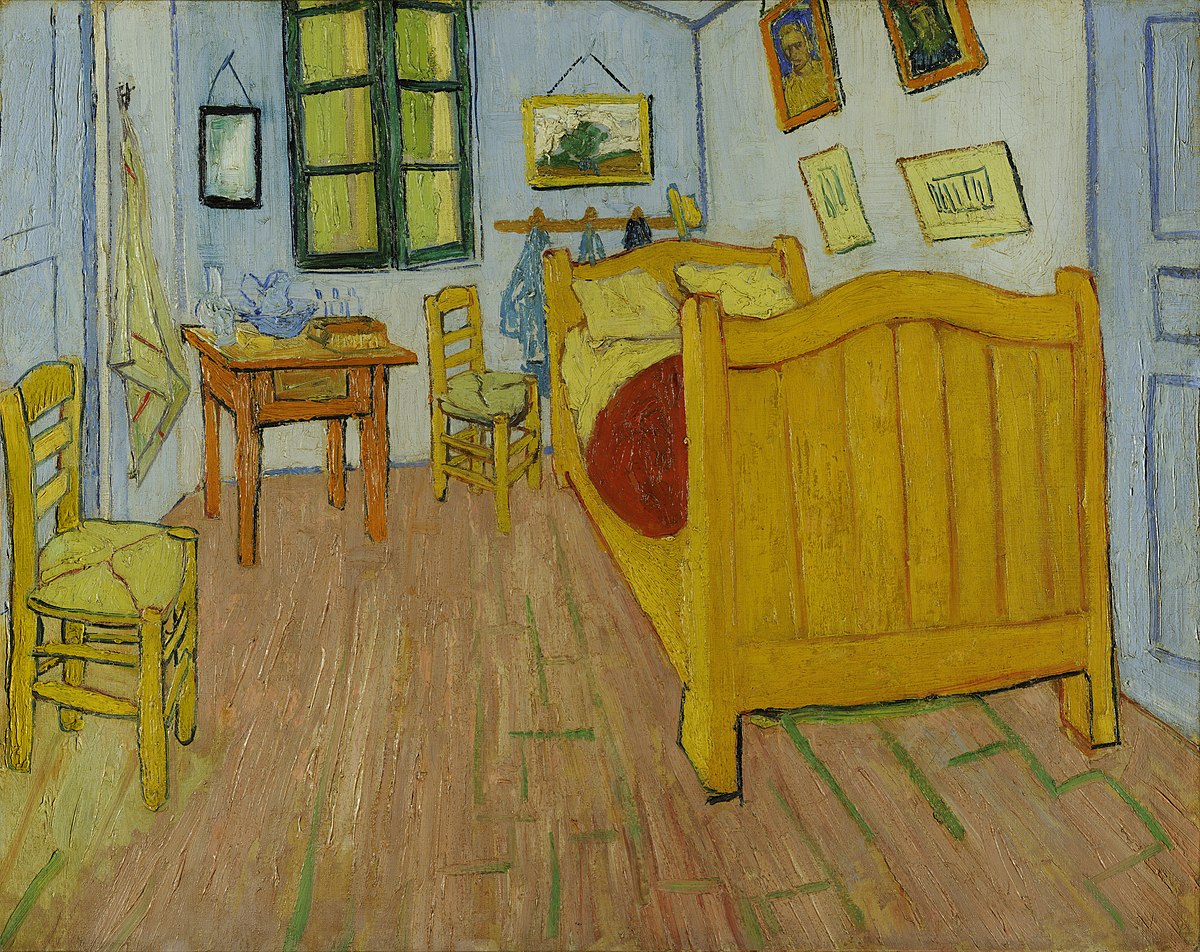
Museum Catalogue Entry
The Bedroom
Vincent van Gogh
A room that bends in order to feel still
Van Gogh turns an irregular bedroom into an emotional self-portrait, using tilted geometry, paired objects, and intense color to pursue what he called absolute rest.
Historical Context
In February 1888, Van Gogh left Paris for Arles in search of southern light. In September he rented the Yellow House on Place Lamartine and imagined the Studio of the South, a community of artists. Painted in October, just before Gauguin's arrival, this room becomes a refuge: a modest sanctuary of order, rest, and hoped-for domestic security.
Artist Biography
In Arles, Van Gogh searched for a direct art of strong color and emotional sincerity. Everyday subjects became charged with meaning. His own bedroom is almost a self-portrait without a body: an image of solitude, friendship, discipline, and the wish for a stable artistic life.
Color Palette
Van Gogh described pale violet walls, a faded red floor, chrome-yellow furniture and a scarlet blanket, held apart by strong outlines and almost no white. Light-sensitive red lake pigments have faded, so the walls now look bluer and the floor less pink-red than he intended. Technical study and paint once protected by the frames have helped researchers reconstruct the earlier colors digitally.
Perspective
The real room was trapezoidal rather than rectangular, but Van Gogh intensified its uneven angles. The walls tilt inward while the table and straw chairs appear to lean toward the viewer. Flat color, bold outlines and coarse impasto, informed by Japanese prints, bend the space into something subjective and intimate.
Symbolism
The bed, chairs, portraits, towels, bottles, mirror, and closed window turn the room into a theatre of intimacy. The repeated pairs of objects suggest order and companionship, while the closed green window protects the interior from the outside world.
Look Closely
- Follow the floorboards into the depth of the room.
- Compare the pairs: two chairs, two pillows, two portraits, two bottles.
- Look at the small mirror beside the window: what does it fail to reflect?
- Notice how the yellow bed dominates the right side of the composition.
Look Closely
The room looks simple, but its instability is carefully staged. Trace how objects, colors, and tilted lines turn architecture into feeling.
12345
- 1The yellow bed. Its large solid form makes rest the physical and emotional center of the room.
- 2Paired objects. Chairs, pillows, portraits, and bottles suggest order, companionship, and absence.
- 3Pictures within the picture. The portraits help distinguish the three authentic versions.
- 4Forced perspective. Floorboards and furniture appear to rise or fall toward us, amplifying the trapezoidal room.
- 5The empty mirror. Its pale surface refuses a clear reflection and intensifies the artist's absence.
Timeline
- 1853 Van Gogh is born in Zundert, Netherlands.
- 1888 He moves to Arles and rents rooms in the Yellow House.
- 1888 He imagines the Yellow House as the Studio of the South.
- 1888 In October, he paints The Bedroom as an image of rest and private space.
- 1889 At Saint-Remy he paints a full-size replacement, now in Chicago, and a smaller reduction for his mother and sister Wil, now in Paris.