Artwork 024 · Impressionism
Museum Catalogue Entry
Impression, Sunrise
Claude Monet
The painting that named a movement
A fleeting dawn over Le Havre became a manifesto for modern vision: light, atmosphere, and immediate perception replace polished academic description.
Historical Context
Monet painted the outer harbour of Le Havre from the Hôtel de l’Amirauté around November 1872. When shown at the independent group’s 1874 exhibition, its title helped critic Louis Leroy coin the label “Impressionists.”
Composition
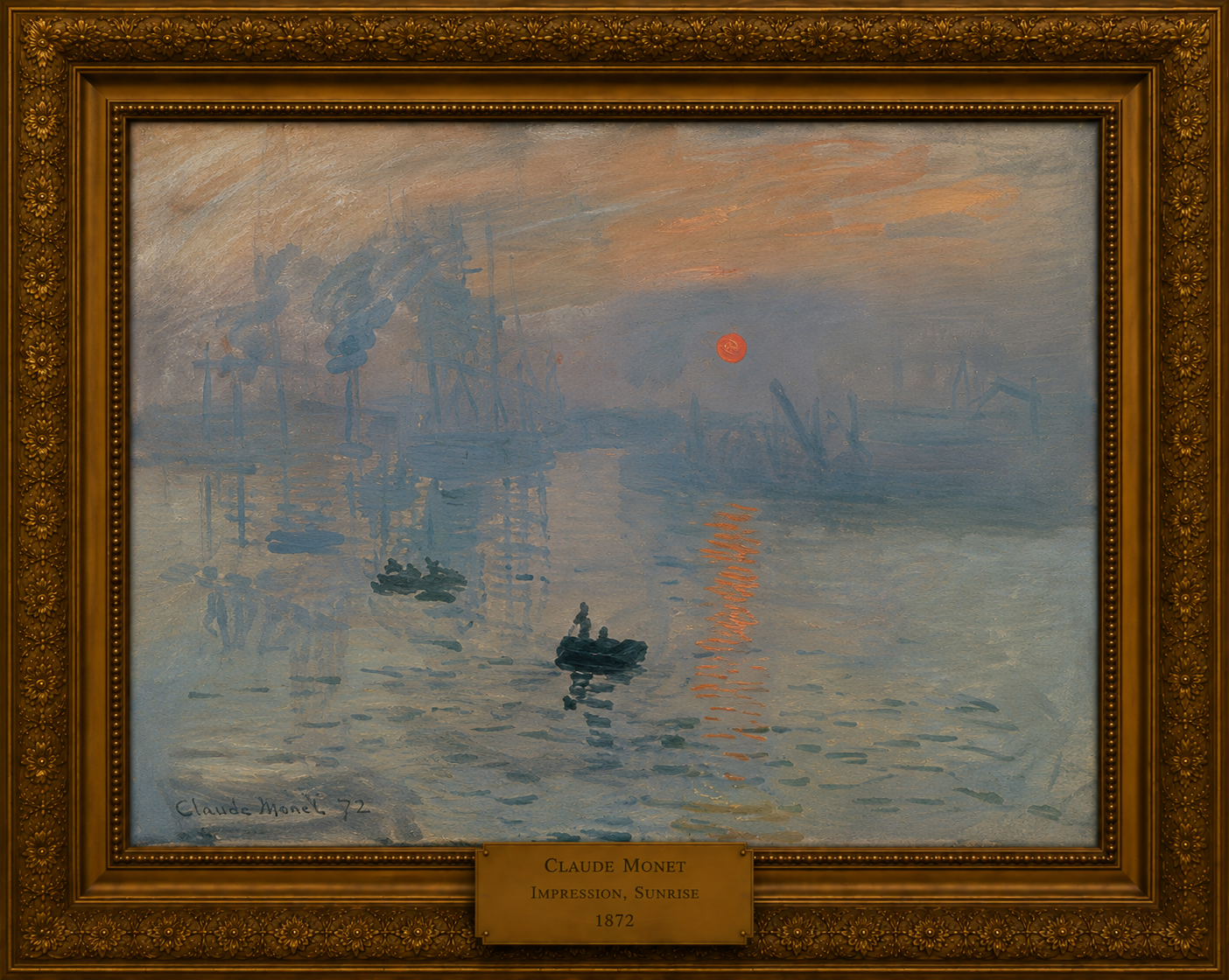
Three dark boats guide the eye into the harbour. The slightly off-centre sun and its vertical broken reflection form the focal axis, balanced by the horizontal strokes of the water. Masts, cranes, smokestacks, and quays dissolve into mist behind them.
Colour and Light
Blue-grey vapour fills the harbour. Against it, the complementary orange sun appears unusually intense. The contrast communicates light without conventional modelling.
Brushwork and Perception
Thin, rapid strokes preserve the speed of observation. Close up, water and boats separate into economical marks; from farther away, the viewer’s eye assembles them into a convincing scene. Detailed description is replaced by an experience of seeing.
Atmospheric Depth
The foreground boats remain comparatively solid, while masts, cranes, chimneys, and buildings lose their contours as they recede. Light and vapour create distance more strongly than conventional geometric perspective.
Modernity
This is not an untouched natural landscape. Industry, transport, mist, and morning labour share the harbour, making the painting an image of modern life as well as atmosphere.
Scale and Impact
At approximately 48 × 63 cm, the canvas is modest rather than monumental. Its influence comes from the economy of its means: a few boats, industrial silhouettes, mist, water, and one orange sun evoke an entire environment and a new theory of painting.
A New Definition of Finish
What appeared unfinished to hostile critics was a deliberate shift in priorities. Monet completes the visual experience rather than every object: the painting records how a place reaches the eye under one particular condition of light.
Look Closely
Move close to separate Monet’s marks, then step back and watch the harbour reassemble in your perception.
- 1Follow the vertical orange reflection across the horizontal water strokes.
- 2Compare the solid foreground boats with the dissolving industrial background.
- 3Observe the separate blue-grey and orange marks from nearby.
- 4Step back and notice how the eye reconstructs a working port from very little detail.
Timeline
- 1872 Monet paints the harbour at dawn.
- 1874 The work appears in the first Impressionist exhibition.
- 1940 It enters the Musée Marmottan collection through the Donop de Monchy bequest.
- Today It remains a defining work of Impressionism.